What if some of the emotions you carry today have a story you don’t completely remember? What if a fear, a relationship pattern, or a feeling of familiarity with a certain place seems to come from somewhere beyond your present experiences?
Questions like these are one reason past life regression has attracted so much attention. For some people, it is a spiritual journey. For others, it is simply a fascinating way to explore the subconscious mind. And for many, it becomes a deeply personal experience that encourages them to look at their life from a completely different perspective.
But there is also plenty of confusion around the subject. Is past life regression scientifically proven? Are the memories people experience during a session actually memories from another lifetime? Can hypnosis really take someone into a past life?
The answers are not as simple as yes or no.
To understand past life regression therapy properly, it helps to look at both sides—the spiritual beliefs surrounding it and what psychology and scientific research can currently tell us.
What Exactly Happens During Past Life Regression?
A regression session usually begins with a conversation between the client and a past life regression therapist. The person may talk about a particular concern, recurring emotion, fear, relationship issue, or simply their curiosity about past lives.
The therapist then guides the person through relaxation techniques. Slow breathing, visualization, and focused attention are commonly used to help the individual enter a deeply relaxed state.
From there, the therapist may use carefully worded questions to encourage the person to describe whatever comes to mind.
It could be a picture.
It could be a feeling.
It could be a particular place.
It could even be something as simple as a sensation or a single word.
Not every session produces a dramatic experience, and that is perfectly normal.
The important part is that the person is encouraged to observe rather than force an experience.
The Most Interesting Part: Why Does It Feel So Real?
This is where things become fascinating.
People undergoing past life regression therapy sometimes describe their experiences with extraordinary detail. They may talk about unfamiliar clothing, buildings, landscapes, relationships, or emotional events.
Because the experience can feel incredibly vivid, it is natural for someone to conclude, “I must have actually lived this.”
But feeling real and being historically verified are two different things.
The human brain is capable of creating extremely convincing experiences. Dreams are a simple example. While dreaming, an imaginary environment can feel completely real until we wake up.
Similarly, hypnosis, imagination, memory, expectation, and emotion can interact in complex ways.
This doesn’t make the experience meaningless. It simply means that we should be careful about claiming that every image or memory represents a literal previous life.
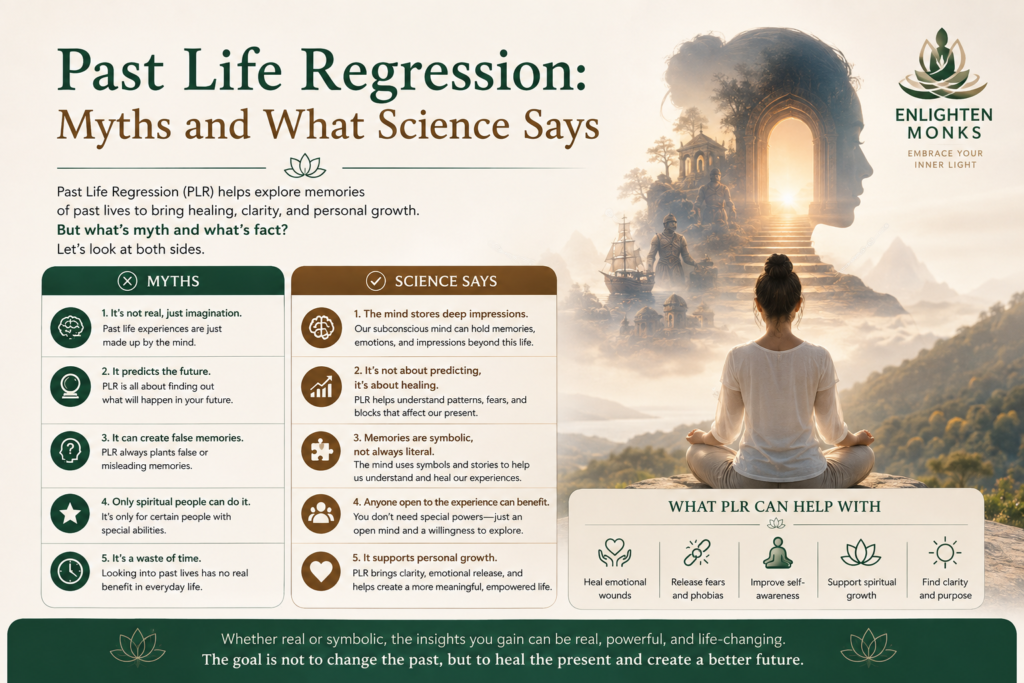
Myth #1: Past Life Regression Proves Reincarnation
This is probably the biggest misconception.
A person experiencing a regression may genuinely believe that they have accessed a previous lifetime. However, individual experiences cannot scientifically prove that reincarnation exists.
At present, mainstream science does not consider past life regression to be established evidence of previous lives.
That doesn’t mean people cannot explore the subject from a spiritual perspective. It simply means that spiritual belief and scientific evidence should not be presented as the same thing.
A responsible past life regression therapist should be comfortable acknowledging this distinction.
Myth #2: Your Therapist Can Tell You Who You Were
You may have seen videos or stories claiming that a therapist can reveal exactly who you were, where you lived, what your name was, and how you died.
Real regression work should not be treated like a history lesson.
A therapist cannot objectively verify every detail that emerges during a session. The role of the practitioner should be to guide the experience, not create a story for the client.
If someone tells you exactly what your past life was before you have even experienced anything yourself, it is worth approaching the claim with caution.
Your experience should be your own.
Myth #3: You Lose Control During Hypnosis
Movies often portray hypnosis as a state where someone becomes completely unconscious and can be forced to do anything.
That’s not how a typical regression session works.
During a guided regression, the individual generally remains aware of the therapist’s voice and can communicate throughout the experience. They can also choose to stop if they become uncomfortable.
The relaxed state may feel unusual, but it does not mean that your ability to make decisions simply disappears.
Understanding this can make the experience much less mysterious for someone considering past life regression for the first time.
Myth #4: Everyone Will See a Past Life
Another common expectation is that you will close your eyes and immediately see an entire previous lifetime like a movie.
In reality, experiences vary.
One person may see detailed imagery. Another may experience emotions without pictures. Someone else may remember only fragments. And some people may not experience anything that they interpret as a past life at all.
There is no “correct” experience.
Trying too hard to produce a particular memory can actually make the process less natural. A good therapist allows the experience to develop at its own pace.
What Science Says About Memory
To understand the scientific side of regression, we need to understand something important about human memory.
Memory is not like a video recording stored perfectly inside the brain. We reconstruct memories whenever we recall them.
Our memories can be influenced by emotions, suggestions, expectations, conversations, imagination, and information we have encountered previously.
This becomes particularly important during hypnosis.
Because people can become highly focused and responsive to suggestions during hypnotic states, the questions asked by a therapist may influence what comes to mind.
This is one reason researchers are cautious about treating hypnotically recalled experiences as completely accurate historical memories.
Can False Memories Feel Real?
Yes.
This is one of the most important things to understand before exploring regression.
A person can sincerely remember something that did not happen exactly as they remember it. They are not necessarily lying or deliberately creating a story. Their mind may genuinely present the experience as a memory.
This is why a responsible approach to past life regression therapy avoids statements such as, “Everything you saw definitely happened.”
Instead, the experience can be explored for its emotional meaning and personal significance.
Then What Is the Value of Past Life Regression?
This is perhaps the most interesting question.
If science cannot prove that regression memories are literally from previous lives, why do people continue exploring them?
Because the experience can encourage self-reflection.
Imagine someone who has struggled with abandonment for years. During a regression session, they experience a powerful story involving separation and loss.
Whether that story represents a literal past life, a symbolic expression of their subconscious, or a combination of memories and imagination may be impossible to establish.
But the experience may still help them recognize something important:
“I am carrying a deep fear of being left behind.”
That realization can become the beginning of meaningful personal growth.
Past Life Regression as a Tool for Self-Discovery
The real attraction of past life regression may not be discovering who you were. It may be discovering who you are now.
The process can encourage people to ask questions they normally avoid.
Why am I afraid of this?
Why do I react so strongly?
Why do I keep repeating this relationship pattern?
Why does this particular situation affect me so deeply?
These questions can lead to greater self-awareness.
For some people, that awareness becomes more valuable than the actual regression story.
The Role of an Experienced Therapist
Because regression can bring up strong emotions, the person guiding the session matters.
An experienced past life regression therapist should create an environment where the client feels comfortable and respected. They should avoid forcing conclusions and allow the individual to interpret their experience thoughtfully.
The therapist’s job is not to convince someone that reincarnation is real.
It is to guide the person through the experience and help them reflect on what it may mean for their present life.
That difference is important.
A Better Way to Approach Past Life Regression
You don’t have to choose between being a complete believer and a complete skeptic.
There is another option: curiosity.
You can approach past life regression therapy with an open mind while still asking sensible questions.
You can appreciate the spiritual meaning of an experience without calling it scientific proof.
You can explore a powerful memory without assuming that every detail is historically accurate.
And you can use the experience as an opportunity for self-reflection without becoming dependent on it for every decision in your life.
This balanced approach allows the journey to remain both meaningful and grounded.
What Should You Expect From a Session?
If you are considering past life regression, go into the session without expecting a particular result.
You may experience vivid images.
You may feel unexpected emotions.
You may remember something that seems familiar.
Or you may simply enter a deeply relaxed state.
All of these experiences are possible.
The goal should not be to have the most dramatic story. The goal should be to understand yourself a little better.
Final Thoughts: Between Belief and Evidence
Past life regression remains a fascinating subject because it sits at the intersection of spirituality, psychology, memory, and personal experience.
Science has not established that the memories experienced during regression are objectively memories from previous lives. At the same time, people can have deeply meaningful experiences during these sessions that encourage reflection and emotional insight.
Perhaps the most useful question is therefore not simply, “Was this really my past life?”
A more meaningful question might be:
“What can this experience teach me about my life today?”
That shift in perspective can make past life regression therapy a more thoughtful and responsible journey.
Whether you approach it as a spiritual exploration, a form of guided self-reflection, or simply an opportunity to understand your subconscious mind, the experience can encourage you to look inward.
And sometimes, the most important discovery isn’t about who you were in another life.